


I stepped tentatively into the extraordinary Venice Biennale International Festival of Contemporary Dance, orchestrated by its Director of Dance, Wayne McGregor. It was my fondness for Mahler’s Fifth Symphony that prompted my first step, leading me to the Teatro Malibran to see Five Days in the Sun. This performance, co-produced by the Biennale, translates the symphony’s five movements into as many tableaux staged by Emanuel Gat Dance. Founded in Tel Aviv in 2004 by the Israeli choreographer, the company relocated in 2007 to the Maison de la Danse in Istres, Provence. Now, it is opening a new chapter in its life with twelve exceptionally talented dancers from around the globe who have settled to work and live in Marseille—a Mediterranean hub and a melting-pot city that has served as a crossroads for migration and trade since its founding in 600 BC. I realized that the journey, and the search for identity among individuals and communities in a state of (trans)formation, were ways of exploring the festival’s underlying theme: time… and the space to which it is inextricably linked. On stage, the performers interpret the sounds of the superb recording by the Vienna Philharmonic conducted by Leonard Bernstein—a version Emanuel Gat has explicitly cited as the finest available.
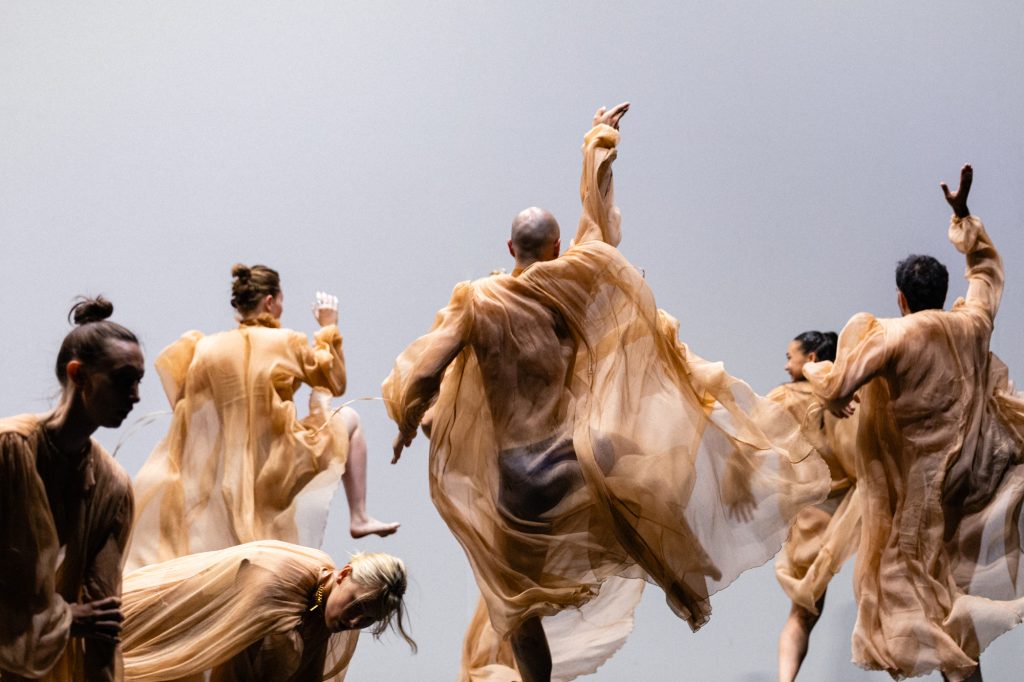
To paraphrase Le Corbusier, we might say that “dance is the skillful and rigorous play of bodies under the light”. Here that light becomes a dynamic, complex web within a scenography of essential abstraction, perfectly fused with the music. Gat’s choreography explores transformation, resilience, and catharsis, orchestrating the unfolding of a stirring performance featuring sheer veils, as airy as the bodies themselves, which seem clad in the very air through which they soar with fluid, light movements, defying gravity. I expected a top-tier dance performance, but I found so much more: bodies moving with mastery, command, and an ease that could only stem from meticulous physical training, and choreography crafted with such precision that even the “punctuation” of the movement was carefully considered. Alongside the veils designed by Polish artist Inez Vichere, casual attire for relaxing at home also appears on stage, bridging the gap between performer and spectator. I found myself transported from the auditorium onto the stage, becoming a dance of airy caresses myself, in a kind of transference reminiscent of Carlo Rovelli’s theories about entanglement (or quantum correlation), that special bond between particles described by a single wave function, where measuring the state of one instantly determines the state of the other, regardless of distance. This relationship between the performance, the dancers on stage, and the audience in the hall offers a unique way to explore the nature of time.

In the talk following the performance, Gat spoke of the body’s “opinion”, which the dancers bring to the stage with a certain degree of autonomy. The phrase struck me, because I had always viewed the body as an instrument of knowledge and a repository of experience, but I had never considered that it might possess its own cognitive autonomy. I asked him about this as we were leaving, and he replied, “The body has its own intelligence, and therefore, its own opinions.” I was taken aback. Realizing that I did not understand sparked a profound question that compelled me to seek answers. That is how I became captivated by the unfolding of a rich theory articulated in conferences, talks, videos, and workshops that defied reduction to a mere schedule of performances. It was, in fact, Theoria, a term rooted in the Ancient Greek thèa (sight, spectacle, panorama, and hence “theater”) and horào (to see, to observe). Originally, Theoria signified the act of observing reality or witnessing a ceremony, and indeed, the Biennale Danza offered spectators a series of ever-changing rituals performed by dancers/sacer docens, who transformed their bodies into temples of movement.

Not knowing how to dance, I took a leap into the darkness of the theater halls, and then rediscovered the concept of “body intelligence” along the way as the festival unfolded like a whirlwind trip around the world in just fifteen days, far outpacing Jules Verne’s eighty. Time Does Not Exist is the title Sir Wayne McGregor gave the festival; while the statement may seem like a piece of theatrical hyperbole, it rests on a precise scientific foundation found in the quantum physics theories of Carlo Rovelli, which the maestro here translates into the festival’s programming and the bodies of the dancers.

McGregor (born in Stockport, UK, 1970) is a choreographer and director whose works feature in the repertoires of dance companies across the globe. His characteristic curiosity and restless, globetrotting spirit have granted him deep insight into all that moves within and around the world of dance, from its core to its furthest reaches. This has allowed him to organize a program that offers the audience a spiritual experience, presenting the spirit of diverse places within the context of the zeitgeist of our own era. This present is an intermediate state that fully encompasses the time from yesterday to tomorrow, because is not a state of suspension, an epoch that halts or excludes; rather, it is an inclusive threshold of co-presence “between”, a sublime instant where the illuminated past coexists with the future still in its nascent state.

The audience was gifted the magic of dancing while motionless, anchored in a seat that transformed into a flying carpet, that magical device that does not belong only to Aladdin, because in addition to Persian and Arabian myths it also appears the adventures of Baba Yaga, the legendary figure of Slavic mythology, who is found in Russian, Ukrainian, Polish, Slovak, Bulgarian, Czech, and Belarusian folktales. It is a figure in magical rituals across the old Slavic lands of Carinthia (Austria), a carnival character in Montenegro, and a spirit of the night in Serbia, Croatia, and Bulgaria. This magical, anti-gravitational device is deeply linked to dance—a perpetual challenge to the force of gravity—and, in our case, it transports us from Lapland to Madagascar, from China to Japan, and from Europe to Australia.

In 1992, Wayne McGregor founded the Random Dance Company (which is now known as Company Wayne McGregor) almost as if to identify him with the word ‘random’, a term that describes something characterized by sudden shifts in direction, lacking a fixed pattern or orderly plan—traits that define his dance, which rests on the solid impermanence of spontaneous improvisation and rigorous freedom. While dance remains the permanent center of gravity for his work, it spans a multitude of fields: from technology to the visual arts, from cinema to total theater, and from opera to artificial intelligence.

This festival is a provocation that does not end when the event itself concludes; rather, the festival serves merely as a starting point. It sparks interest and a desire to follow the trajectories of the artists, companies, and performances we hope to see on our theater bills, but it also stirs curiosity about all we do not know among those who realize that knowledge is a progressive process, and an ever-growing awareness of one’s own unbridgeable ignorance. The Biennale plays a vital role in culture and advanced training across all its various sectors. It reveals the tip of the iceberg of avant-garde production—a tip that will shift by the next edition to expose what was previously submerged. It also stands as the spearhead of artistic production, elevating standards through the excellence it showcases; for, much like wine, once you have tasted the finest, it becomes impossible to settle for drinking the ordinary.
…to be continued…


Aggiungi la tua firma e il codice fiscale 94097630274 nel riquadro SOSTEGNO DEGLI ENTI DEL TERZO SETTORE della tua dichiarazione dei redditi.
Grazie!